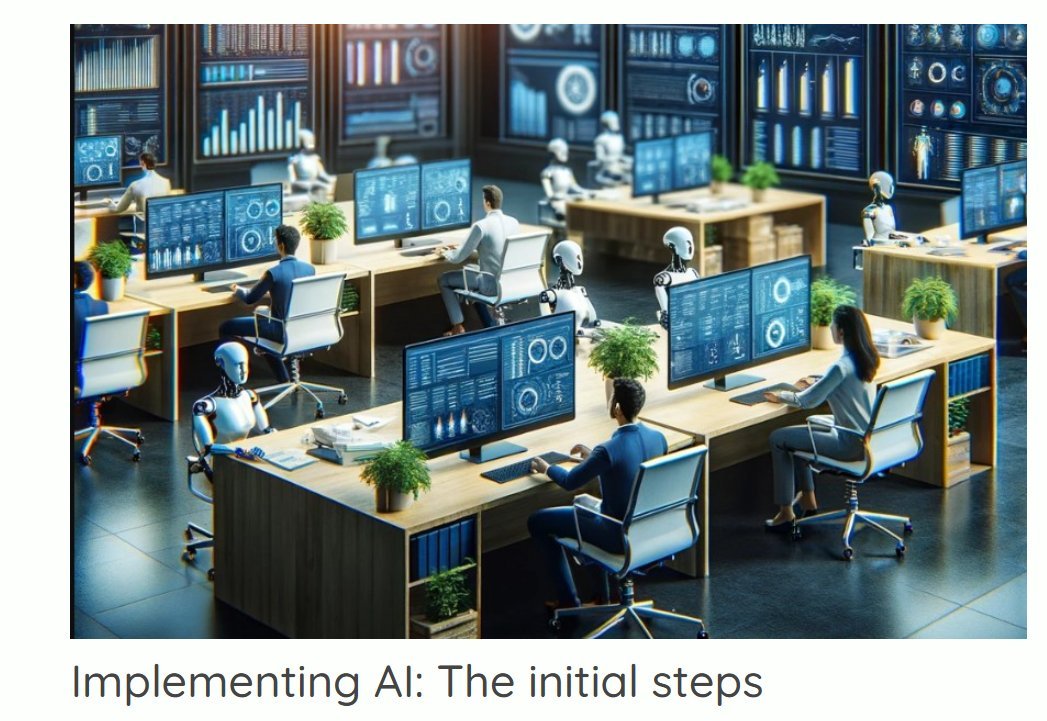
ChatGPT was launched in 2022. In the beginning, it was mainly individual employees who adopted the tool, sometimes secretly using it to enhance their own productivity.
These days, surveys show that large firms are starting to adopt ChatGPT and other similar tools in a more official and systematic fashion.
Where should they begin? How do you estimate the potential gains from implementing AI in different areas - and gain a better understanding of the organizational implications?
This is a question we have been discussing in Reconfig over the last few months internally as well as with some of our partners (consultants who are helping clients implement AI) and external experts. As a result, we recently launched a new set of features that complement the existing capability of the tool to support organization design processes.
The new features are based on three key insights - each one reflecting a common mistake organizations make when they start their AI implementation journey.
1. Focus on activities, not jobs
The first insight relates to the “unit of analysis.” Many consultants start with an analysis of jobs or “job families” to estimate the potential productivity gains from automation or augmentation. Reconfig focuses on activities or work processes instead.
This is because a single job may consist of a number of different activities, only some of which can be automated - and most can only be partially automated. Or vice versa, the automation of a single activity may have an impact on multiple jobs.
So Reconfig’s key unit of analysis is the activity, with a drill-down into specific tasks within the activity. This gives organizations a far more accurate and actionable picture of where AI can actually deliver value.
2. Combine external benchmarks with internal data
To estimate the potential gains, there are two main approaches: external data (generic studies) and internal data about how time is actually spent. Generic estimates are rarely actionable. Internal data tell you what’s actually true for your organization.
We decided to rely on both. First, we use large language models to analyze the activities of the organization and produce well-reasoned estimates for the likely percentage improvement of generative AI in each activity. These estimates should be reviewed by managers and internal experts and adjusted based on their knowledge and experience.
Reconfig then combines these estimates with the activity profiles of the employees - which state how much time each employee spends on each activity. These data provide a detailed breakdown of the potential productivity gain from generative AI per employee, per team, and for the organization as a whole.
3. The next phase: domain-specific AI agents
Organizations will need to move beyond generic language models such as ChatGPT to realize the full potential of AI. The next phase consists of building domain-specific systems that in some cases fully automate processes.
The most typical example is an AI agent trained specifically for a clearly defined and targeted role in the organization. You can think of an AI Agent as a highly efficient remote employee that you can only reach digitally. You ask the agent to perform a task; it gets to work and queries you when input or verification is needed. You then sign off on the final result.
In this manner, agents could even be placed on your organization chart as a valuable part of your team - with clear accountability, defined interfaces, and measurable output. This is precisely the kind of Human-AI co-intelligence design that Reconfig’s Organizational Digital Twin is built to support.